


Introduction
The Middle East is likely the most complex region in the entire world and yet most Americans have only the knowledge gained over these last 25 years of war. Prior to September 11, 2001, Americans were still searching for Kosovo on a map, and had not even thought about the Middle East much more than Jesus’ hometown and oil. The problem for the average American is that we don’t think the way much of the world does. We exist in a bubble of capitalism and freedom that preaches American exceptionalism. To be clear, I love exceptionalism but the application of that exceptionalism can have consequences. This American Creed, by its very nature, requires an American to think of themselves as the standard of excellence by which the entire world is measured. While this may be provably true through mathematics and markets, it lends to skew our perspective to the assumption that America is the best, does everything the best, and everyone else thinks just like us.
For citizens of the West, we tend to have a strong understanding of the government and what it is; its function. We have clear distinctions between the Federal and State level and the ways in which each tier are equally devoted to maintaining the order of law. Look at your community and you will find government functions everywhere. There are fire and police departments, ambulance service, public transportation, public roads, food stamps, welfare, childcare, homeless outreach, medical clinics, and the list goes on. When we start to really think about our society, we begin to see just how many public services our government offers at both the state and federal level.
Another measure of a civil society is how it deals with social unrest and violence. In many countries, cities are well regulated and controlled by the government, however, once one finds themselves outside of those city boundaries, one is often outside of the government's reach as well. That is to say that, in many nations around the world the government does not control the rural regions within its own borders. The rural regions are controlled by the leaders of the people that live there and methodology is often in conflict with the rules of the State.
In America, this is not the case and one can simply look to any number of examples in history where Federal Law Enforcement took jurisdiction and restored order when the state could not resolve the issue . You may argue the methodology of the policing, my point is that here in America, there really isn’t any geographic region where anyone can escape the reach of the federal government. This is important to keep in mind because for much of the Middle East this simply isn’t their reality.
It is also very important to understand the difference in perspective and how that impacts our interpretations and formulates our opinions. America is truly a unique experiment and I would suggest that we are more the exception than the standard. For a great deal of the world outside of America and Europe, the religious center (church, temple, mosque, etc) is the foundation of their community. In those societies, they view the religious center as being ahead of the government in importance in their lives. You could argue their faith is stronger, but the true reason is because the church provides them with more than the government does.
The social safety net we have in America (in the form of Medicaid, food stamps, welfare, social security etc), does not exist in the majority of the world. For much of the world, and America traditionally, the social safety net came from the religious center within the community in which it served. The society and culture are therefore built around that which is the caretaker of the community. In Western society, we have replaced that with the government. The church is our religion and the government handles everything else. Western society, without intending to (or maybe intending to), removed the glue that placed the church in the center of the community and subsequently changed the way we as a society view our faith.
Much of the Middle East does not think this way, in fact, their politics are a product of their faith. There is no separation. For American Protestants this is tough to understand because we have a strong doctrine of separation of church and state. Protestants are not completely united politically, they do lean heavy to the right, but not completely united the way other communities are. This is often because most people around the world retain both an ethnic identity and a religious identity that sometimes are difficult to separate and takes precedent over the national identity. For the West, societies were built upon national identity and religious identity, as tribal or ethnic identity was cast out as disruptive and divisive. People began to build religious nations and not religious tribes. This was the beginning of empire.
The Western World is data focused and thus looks forward and creates new methods and products to aide in the furtherance of progress. For many people, they tend to look backward into history and tradition to gain the answers for the present. Americans are always looking forward for wisdom, while others look into the past. There is a tendency in Americans to believe that humans of the past were not as smart as us because they didn’t have machines and technology, but I would argue the way you define intelligence or wisdom is at the core of the issue.
A Brief History of the Christian Church
No disrespect here, but Protestants are usually the least educated regarding the history of the Christian Church. We don’t really have a strong sense of where we came from. It is a worthy endeavor to understand that the Protestant branch of Christianity can be thought of as a reaction to the Catholic Church and its function and practices at that time in history. Protestantism came out of Catholicism as Martin Luther was a Catholic Priest when he wrote his Ninety-Five Theses in 1517 CE. Even though Protestant theology sought to dissolve the control of the church, it retained much of its structure and framework from the Catholic Church at first. This can be seen in the Lutheran or Anglican/Episcopalian branches. Moral of the story, there was a ton of Protestant thought coming out of England (which is where many Protestant denominations come from; they followed a thinker). Beginning in 1642 CE, there were a series of Civil Wars in England and many people fled to the colonies in America as a result. This was the seeding of Protestantism in America.
For approximately 1,000 years, the church was known only as the Christian Church. It was broken up into regions to make it easier to govern but the church was global and unified. In July 1054 CE, an event occurred in the Christian Church that is known as “The Great Schism” or “The East-West Schism”. The church in Rome wanted to do certain things differently than had been traditionally done and they had a few different interpretations of the scriptures that conflicted with the current church understanding, but mostly because they wanted a Pope. Therefore, the church divided and the Western Church in Rome became the Holy Roman Catholic Church. The remaining network of Christian Churches are today known as Eastern Orthodox. As we understand the history of the Christian Church and the divides that created friction and disrupted unity, we can better understand the context of history and apply lessons learned to our perspectives today. Building off of our understanding of the Christian Church and The Great Schism of 1054 CE that divided the church, we can begin to examine an equal parallel in the history of Islam.
A Brief History of Islam
Islam officially began in 610 CE when Muhammad received his first divine revelation. At the time of Islam’s founding Judaism was present in the Middle East as it always had been and Christianity largely surrounded the Arabian Peninsula courtesy of the Byzantine Empire (Rome). The bulk of the interior of the Arabian peninsula was still largely tribal and polytheistic with no great religion unifying them. Islam would become the solution to this problem. Judaism and Christianity share the same heritage but argue over who Jesus is/was. Islam says that Judaism and Christianity get it wrong and Islam is the correct way that was lost over time and restored through Muhammad.
With this new message from God, Muhammad began preaching and building his following in Mecca until he was forced to flee to Medina. In 630 CE, Muhammad returned to Mecca with his followers and a series of battles occurred, with Muhammad and his followers emerging victorious. With word of his conquest spreading, many regional tribes sent delegates to Mecca to affirm conversion to Islam. Muhammad dies shortly after the conquest of Mecca in 632 CE.
After Muhammad’s death, Islam was left without a leader and conversations began amongst his most respected followers as to who should become the new leader of Islam. These conversations lead to the most significant schism is Islamic history. This schism is known as the Sunni-Shia split.
The majority belief then and now is the Sunni view. The Sunni’s believe Muhammad left no designated successor and the community should choose the leader based on piety and capability. Upon this belief, Muhammad’s close friend and father-in-law Abu Bakr was chosen as the first Caliph (successor).
The minority belief then and now is the Shia view. The Shia believe that Muhammad had divinely designated his cousin and son-in-law, Ali ibn Abi Talib as his successor and that his successor should come from his lineage (bloodline). The term Shia comes from Shi’at Ali, meaning “The faction of all”, further strengthening their belief in bloodline succession.
The first three Caliphs were Sunni choices, Abu Bakr, Umar, and Uthman and it wasn’t until the fourth Caliph was selected, Ali, that the Shia finally saw their choice selected for Caliph. Unfortunately, it was short lived for the Shia as Ali’s reign was marred by Civil War and he was assassinated (by a poison sword) in 661 CE. Shortly after his death, rival Sunni clans established the Umayyad Caliphate in Damascus and Islam transitioned into a hereditary monarchy. Ali’s son, Husayn ibn Ali was angered by his father’s assassination and refused to pledge allegiance to the leader of the new Umayyad Caliphate. Husayn and his family members were traveling through modern day Iraq when a massive Umayyad army attacked them at the Battle of Karbala. Husayn and his family were all massacred and the core foundation of martyrdom and justice were burned into the Shia Muslim theology. The Schism had occurred and Sunni and Shia would never unite again.
Today Sunnis make up about 85-90% of the global muslim population, leaving the Shia as a small minority of 10-15%. Shia muslims are found throughout the Muslim world but are concentrated in the largest populations in Iran, Iraq, Azerbaijan and Bahrain. Iran is the only nation in the world where Shia Islam serves as the foundation for the legal system and government. 90-95% of Iran’s population is said to be Shia Muslim and the Shia form the majority of the population in three additional countries. 63-70% of Iraq, 60-65% of Azerbaijan, and 65-70% of Bahrain are Shia muslim. Pakistan and India, though majority Hindu and Sunni also have large numerical Shia populations (about 20 million each). In Lebanon, Shia muslims make up 45-50% of the population and in Yemen, the Zaydi Shia Muslims (aka The Houthi Rebels) make up 35-40% of the population.
Understanding the demographic distribution of Shia muslims across the Middle East, one can begin to see the complexity of divides within national borders. It seems rather arbitrary when you think about it. It just doesn’t make sense. Why would these countries be formed with clear religious and tribal divisions? Often times it seems that the populations are captured within the national borders to divide and weaken groups of people. Take Bahrain for instance, 65-70% of its population is Shia muslim but the ruling family is Sunni. The border between Iraq and Iran is nothing but a line on a map as the majority of Iraq’s population is Shia muslim and lives on the eastern/south side of the country. The north/western side is where the Sunni’s reside. This isn’t a perfect assessment as distribution is complicated, but it is a general understanding of where people reside traditionally. This is why the Iranian Ayatollah’s body was recently taken into the Shia holy cities of Najaf and Karbala in Iraq during his funeral procession (and also Karbala is where Ali’s son and his family were massacred).
It is easy to assume that the Shia, and all muslims for that matter, are united across all fronts but you’d be incorrect. Just as the Christian Church is divided into Eastern Orthodox, Catholic, and Protestant; Islam is divided into Sunni and Shia. Just as Protestants have as many denominations as stars in the sky, you find the same pattern with the Shia and Sunni Muslims. Within Christianity, many denominations come out of a particular school of thought that is championed by a particular person. John Calvin would be a good example. Islam is largely the same way as divisions are drawn more by interpretation and school of thought.
The Shia are generally divided into three schools of thought, the twelvers, the seveners, and the fivers, that center around the argument of who is the rightful bloodline successor. They get their name from the number of Imams they recognize before the line of succession diverged. In Iraq alone, there are three major Shia sects that center around the religious leader they follow. There are Iran loyalists, like Kataeb Hezbollah and the Badr Organization, who follow the Ayatollah. There are the Traditionalists and Quietists who follow Grand Ayatollah Ali al-Sistani who is based in Najaf, and there are the Nationalists who support Cleric Muqtada al-Sadr and are Anti-Iran. In addition, you have unique belief systems that grew out of Shia Islam like the Alawites and the Druze. The Alawites are primarily found in Syria and the previous ruling family, the Assads, were followers of this minority belief group. The Druze, while tracing roots to Shia Islam, incorporate elements of Greek philosophy, reincarnation and esoteric monotheism. It is very clear the Shia are not aligned at all.
The Sunni are divided into four legal schools of thought and three main schools of creed. The legal schools are Hanafi, Shafi’i, Maliki, and Hanbali and they interpret Islamic law, rituals and daily practices. The schools of creed, Ash’ari, Maturidi, and Athari would be better understood as theological (Aqidah) schools and focus on how to understand God’s attributes, free will, and faith. In addition, there are modern reform movements and philosophies like Salafism/Wahhabism, and Sufism. There are also more organizational forms of Sunni Islamic belief such as the Muslim Brotherhood who are made up of educated professionals who seek to islamize society from the ground up via an inside-the-system approach of running in elections and establishing charities. Inversely the Taliban, who derive their belief system from a mix of Pashtun tribal culture and the Deobandi movement of Southeast Asia, seek to establish an ultra-conservative fundamentalist society that oppresses women and rules through harsh corporal punishment. I wouldn't call the Sunni’s unified either.
With all this is mind, one may wonder how the Middle East came to be divided into these fragile nations with built in divisions that seem to be designed for instability. After all, the Sunni-Shia divide seems to be enough to keep the muslim world fighting forever. Is peace even achievable?
I believe it is worth mentioning that the generalization that is often displayed in the media of all muslims is that they hate our freedom and want to take us all back to the Stone Age. While it is not incorrect to say that some (such as the Taliban) seek a much more rigid and fundamentalist system, to say that all muslims are aligned on that fundamentalist approach is really quite silly. While it might be fair to suggest that the Taliban want us in the “Stone Age”, you can look to another sunni group that doesn’t.
The current leader of Syria, Ahmed al-Sharaa (formerly known as Muhammad al-Jolani) was a high-ranking leader in al-Qaeda for over a decade. He joined the terrorist organization in 2003 after the US invaded Iraq and he served directly under the founder of al-Qaeda in Iraq (which later became ISIS), Abu Musab al-Zarqawi. Zarqawi was famous for the head-chopping videos of the early 2000’s. To be fair, in 2016 al-Sharaa publicly declared his group is no longer affiliated with al-Qaeda and he seems to be taking a more reserved approach to leadership; one could argue that. One could also argue that the reason al-Sharaa is in Syria is because after his release from US military custody for planting explosives against US forces in Iraq, al-Qaeda central command tasked him with establishing the group’s official branch in Syria. That is correct, as soon as he was released from US custody he founded al-Nusra Front which carried out extensive suicide bombings and insurgent operations against the Assad regime, ultimately leading to the overthrow of the Assad regime and al-Sharaa taking power. Is it possible that America had some hand in al-Sharaa’s climb to power? Is it possible that the Middle East is far more complex than the media would have you believe?
An American Perspective
Americans don’t have a rich heritage of cultural rise and fall spanning centuries, nor can we mark history through various empires and conquerors. The United States just celebrated its 250th anniversary and as impressive as it is that the republic is still united, it is but a drop in the ocean compared to the tribes in the Levant and Arabian Peninsula. I say tribes because the nations we see on the map today are relatively new and for many of those who reside in the Middle East, their nation is their tribe of people that has persisted over thousands of years.
“The Nation of Israel”, for example, intertwines both an ethnic and religious identity that is separate from the idea of the state itself. A Jewish person can have any national identity they want, can live anywhere in the world, and they will likely retain the Jewish ethnic and/or religious identity. The Jews have faced many tragedies whether in Germany, Russia, Poland or numerous other locations, and in every case the entirety of the Jewish society living in exile is routinely expelled or worse. What we learn from this is that the Jewish society retained a cohesive cultural structure; had they not done so they would have simply assimilated into their host society. It is because they did not assimilate that they were so easily vilified; they were a visible cohesive culture existing within, yet, outside of the host nation’s culture.
The arbitrary lines found drawn on a map don’t truly encompass the way all peoples think about their history. History is a roller coaster marked by rise and fall and the United States of America is truly at the beginning of that journey. We were second only to the Native Americans who arrived first and it wasn’t long before we threw off the yoke of the British Empire that planted us in the new world. Once a nation, we expanded through Manifest Destiny and drove the Native Americans into reservations where they still live today. This westward expansion ensured America’s security from European colonization and created an ocean buffer zone on both the east and west borders of the country. Due to the Industrial Revolution, America grew into an isolationist industrial powerhouse and began feeding the mechanized war machine of World War I Europe, years before our boys would ever set foot in a trench.
When Japan bombed Pearl Harbor on December 7, 1941, it cemented US involvement in the War in the Pacific and it wasn’t long before America had troops in North Africa and Europe as well. I have no intention of minimizing this tragic event in American history, however, I don’t consider this an invasion. Hawaii is about 2400 miles off the coast of the continental United States and this was an isolated bombing campaign on a US territory (Hawaii did not officially become a state until 1959). Strategically, it was Japan’s only play at the time because getting to the continental United States requires crossing an ocean and a bomber that is loaded down with munitions didn’t get great fuel mileage.
The root of the idea is that Americans have never really known what it is like to have your borders crossed by an invading force. Ask the children who grew up huddling in bomb shelters in London during World War II how that experience shaped their life and their identity. Consider the farmer tending his crops as he hears an unfamiliar sound in the distance. What is that thunder? A line of armed men as long as the horizon emerges from the trees, their synchronized steps echoing against the hills. The farmer knows that he cannot save his family. He and his son will be murdered, his wife and his daughters taken as slaves and likely raped by the captors and his farm and all he built will be burned. America does not have this generational trauma built into our identity.
There was a time long ago in history when taking captives after a military victory was a progressive idea. The standard of the day was to eliminate the bloodline. If two forces engaged in combat, the winning force would often murder every single human being from that losing group. Men, women and children. Eventually this practice fell out of favor for the more lucrative opportunity in the slave trade. Slavery was a standard practice for thousands of years and a huge economic market.
We get the term “slave” from the word “Slav” because during the Middle Ages, so many Slavic people from Eastern Europe were captured and traded to the Byzantine empire and the Islamic Caliphate that the commodity itself (the slave) was branded with a singular ethnicity (Slav). This is no different than Southern folks using the term “Cokes” to describe all soft drink beverages. The problem was so severe that the Russian government levied a special tax to acquire funds to buy its citizens back from slavery.
The only real memory America has of a foreign invasion is honestly more a reflection of our current foreign policy, which makes sense after all, as many sons take after their fathers. The War of 1812 lasted almost three years and it is likely the war that Americans know least about so I think it is fitting to do a quick review.
Here are some of the highlights:
Britain invaded Washington DC and burned the White House down in August 1814.
The US tried to conquer Canada by launching invasions across multiple battle fronts from 1812 to 1814. The burning of the White House was retaliation for the 1813 invasion of York (now Toronto) and the subsequent burning of various public buildings there.
On September 13-14, 1814 at Fort McHenry in Baltimore, MD, over 1,500 bombshells and rockets were fired from British Warships at the Fort. In the morning, a 30’ x 42’ American Flag was still flying over the Fort meaning that American forces had not surrendered. This inspired Francis Scott Key to write the poem “The Star-Spangled Banner”.
The War of 1812 may be reduced to 3 key causes:
The British Navy and its policy of impressment
At the time, Britain was engaged in massive Napoleonic Wars with France which meant men and supplies were desperately needed. The British Navy paid very little salary and was a brutal occupation which lead to a high desertion rate. Many deserters would find work on American Merchant ships that paid more and offered better conditions. France supported the United States during the Revolution that America fought against Britain. This created a strong allied partnership between France and America. America was selling supplies to France via merchant ships and because Britain was at war with France (and probably still a little sore about losing their cash cow colony), they would intercept, board and seize these American merchant vessels. Britain would then forcibly conscript the merchant sailors into the British Navy which boosted their ranks and allowed them to feed their supply lines. Every citizen of the Unites States was originally a subject of Britain and the way Britain saw it, there was no such thing as a naturalized American citizen. Britain felt it had every right to legally reclaim what they saw as their own subjects. America saw it as a violation of sovereignty and unprovoked violence upon an economic endeavor. Has America ever violated a sovereign nation through unprovoked violence in relation to an economic endeavor?
Trade Blockades
America was a young nation and I suspect that when one finds themselves in such a situation it is likely best to back up your allies. America had chosen to continue open trade with its close ally France and was providing various goods that would ultimately support our friend as they were engaged in war with Britain. In response, Britain attempted to restrict US trade with France through the use of naval blockades which ultimately did not sit well with the USA. I suppose in Britain’s defense, they were at war with France and we were supplying their enemy. I suppose Russia has no right to strike NATO for supplying Ukraine, though, that is different. The US definitely has every right to impose a Naval Blockade on Iran because that is also a different situation. Right?
British interference in US Western Expansion
It had become clear rather quickly that, in order to ensure US security, the United States would need to expand west to the Pacific Ocean. Along the way, US soldiers would routinely battle with Native Americans who were not too happy about our practices of taking their land and forcing them into camps and worse. Some of the Native Americans surrendered but some chose to fight. The British would routinely arm these bands of resistance fighters in order to aide them in their struggle against US expansion. America did not appreciate Britain arming the Natives, nor did America like Britain involving itself in the affairs of another sovereign nation (especially since Britain is on the other side of the Atlantic Ocean).
Today there are still nations who routinely confiscate land in separate sovereign states through military force. Today, the United States continues to arm foreign rebel groups in hopes that the established government will be overthrown. Israel continues to expand outward to establish a “buffer zone” and relocates the residents to filthy tent cities. I suppose we learned from the best. Maybe societies are destined to become the oppressors they escape.
Its funny that the only war America actually experienced in the homeland is the war we have forgotten. I find it possible that it was designed that way. History matters a great deal more beyond our Star-Spangled shores and Americans have amnesia. By the early 1900’s we had forgotten the blood libel against Britain and came to her aide in World Wars I and II. Most Americans still venerate Churchill as one of the greatest leaders of all time; viewing Britain as a brother nation who is one of us. This is quite unique outside of the United States, and the greater western world for that matter, as even in other relatively developed nations they simply do not forget.
In June 2026, Ukrainian President Volodymyr Zelensky officially returned the highest Polish state decoration, the Order of the White Eagle, to Warsaw after Polish President Karol Nawrocki announced he was revoking the honor. The reason for the revocation was simple, on May 26, 2026, President Zelensky issued a decree naming a unit of Ukraine’s Special Operations Forces the “UPA HEROES”. This caused a shockwave through the Polish public for one reason; history. The UPA refers to the Ukrainian Insurgent Army who fought Nazi Germany and Soviet Russian forces for independence during the 1940s and 1950s. The UPA is responsible for the ethnic cleansing and massacre of tens of thousands of ethnic Poles in the Nazi-occupied regions of Volhynia and Eastern Galicia. These are crimes still recognized by the Polish Parliament as genocide. A response of solidarity swept across Ukraine as nearly every Ukrainian who had received one, mailed their Polish awards back to Poland in response. Not everyone chooses to forgive and forget.
Traditionally in America, when new immigrant groups would arrive to our shores they would collect in geographic areas together and struggle initially to integrate. Though typically within 3 generations those same groups would largely shed their identity from the homeland for a new American identity. This is because America is a unique experiment in Western and Christian philosophy. I say unique because it truly is unique to completely forget the history of your people simply because you migrate. This does not exist nearly as much outside of the Western World and the mistake of the Western World is assuming it does.
It is also fair to raise the point of marrying outside of your ethnicity and/or religion. The Western World is quite liberal in this regard as we tend to value national identity above that of ethnicity or religion. Many nations, even today, are not as accepting of this practice and it generally has to do with the cultural importance placed upon unbroken religious affiliations and preservation of ethnic lineage. The Jewish people are another great example of this as children inherit Jewish identity on their mother’s side. Traditionally, they inherited their identity from their father’s side but because Jewish men began to intermarry and have children with neighboring tribes, the rule was changed to ensure that Jewish men would marry Jewish women. If the child has to have a Jewish mother to be considered a Jew then it is kind of a fool-proof plan.
When we examine ancient regions like the Levant and the Arabian Peninsula, we must learn to see the perspective of the people that live there. As Americans, we often don’t intend to, but we routinely apply our perspective to everything and everyone in the entire world. This is a foolish mistake. As foreign as it may seem, we must attempt to think differently and see alternative perspectives. We want to try and see things the way that someone else may see them. This not only aides in our understanding of history, it helps us to read the Bible more effectively.
We will not be tracing the timeline of the Old Testament in relation to the Levant and Arabian Peninsula, as that story is mostly tribal territories and regional conquerors. We won’t be diving into the history of the influence of the Roman Empire on the region, nor will we take a detour into the Islamic conquest of the region after 700CE. The easiest way to think about the Arabian Peninsula and the Levant is that it is comprised of many ethnic tribes with unique identities. While the Levant had widespread Jewish and Christian influence, much of the Arabian Peninsula remained polytheistic and ascribed to ancient pagan gods until Muhammad conquered Mecca and the Islamic Caliphate was established in the early 700’s CE. Islam was likely the first real unifier of Arabia.
After Islam conquered the Arabian Peninsula and Levant, it remained in Muslim Empirical control from about 700CE until the end of World War I. At the time of the first great world war, the regions were still considered under the rule of the Ottoman Empire and had the Ottomans not aligned with Germany during World War I, the empire may never have been carved up the way it was. The victors of World War I, the Western World, are directly responsible for the Middle East that exists today. We drew all the lines on the map.
Drawing the line: The Sykes-Picot Agreement
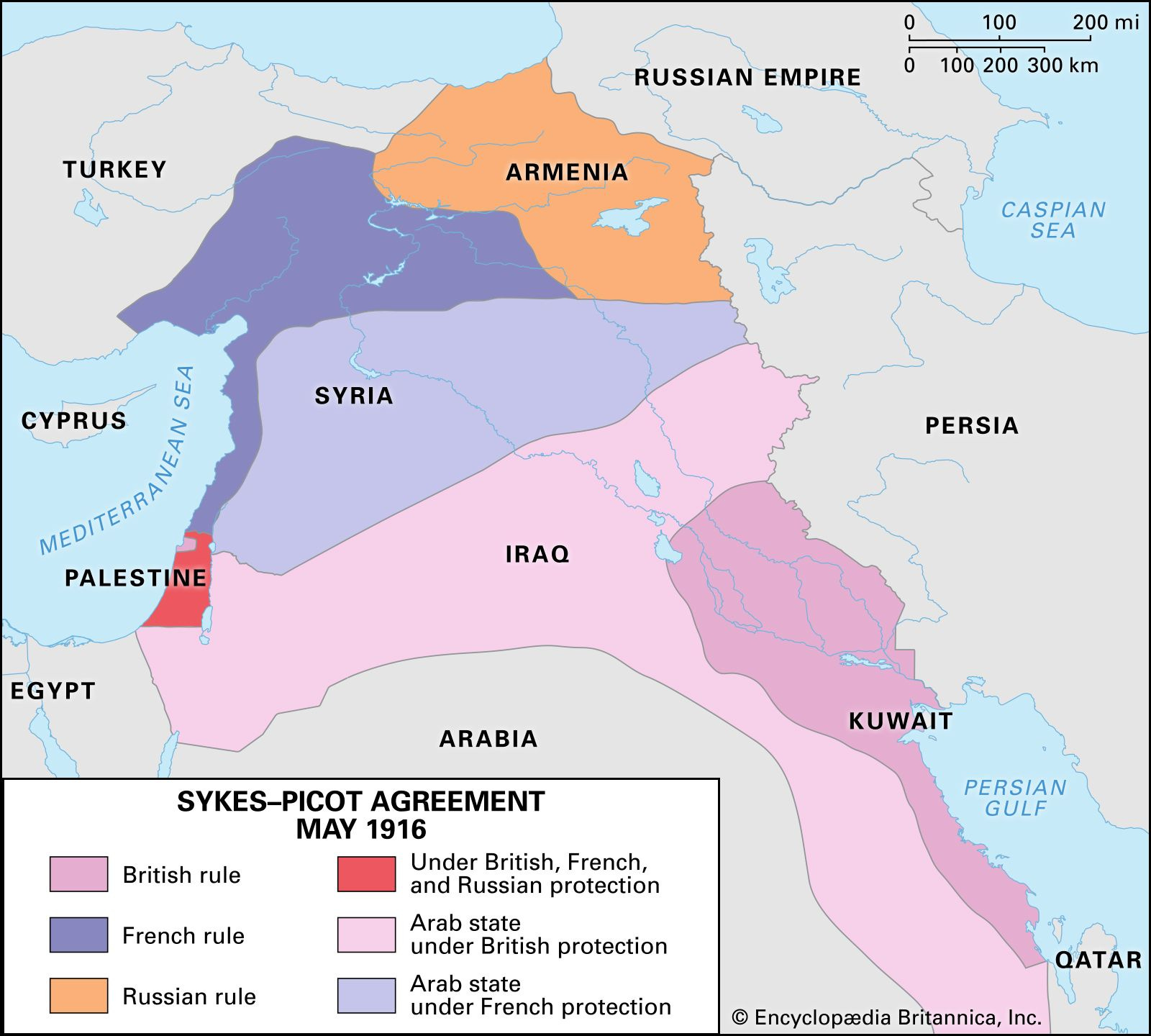
The Sykes-Picot agreement was a secret agreement between France and Great Britain that officially recorded the proposed plan on how to partition the Ottoman Empire after World War I. Signed in May 1916, the agreement was named for its architects British diplomat Mark Sykes and French diplomat Francois Georges-Picot. Tsarist Russia was also in formal agreement with the deal through the negotiation of Foreign Minister Sergey Sazonov who, due to early Russian military successes against the Ottoman Empire, rushed to the negotiating table and forced the signing of the 1915 Constantinople Agreement. Sazonov had been promised Mediterranean Sea access through the acquisition of Constantinople and the Turkish Straits once the Ottomans were defeated. The Ottoman Empire had taken the side of Germany in World War I and was defeated alongside their allies. Sykes-Picot was the plan to carve up the defeated empire by exchanging Ottoman empirical rule for French, British or Russian empirical rule. France received control over modern-day Lebanon, Syria, and northern Iraq. Britain was granted control over modern-day Jordan, southern Iraq, and Palestine.
Sykes-Picot would have been horrible policy on its own, however, once you include the two additional backroom deals, its gets much worse. It began with the “Clash of Promises”, as Britain was trying to secure victory by utilizing various armed elements. In order to secure fighters, Britain made a lot of promises, especially promising multiple parties the same lands.
Britain made three promises:
The McMahon-Hussein correspondence occurred in 1915 through letters between Sir Henry McMahon (British High Commissioner in Egypt) and Sharif Hussein of Mecca. The agreement was, if the Arabs launched a “Great Arab Revolt” against the Ottoman Empire, then Britain would recognize and support an independent Arab kingdom ruling over nearly the entire Middle East. Sharif Hussein was a Hejazi leader and member of the Banu Hashim clan (Hashemite) within the Quraysh tribe, which the prophet Muhammad belonged to. His sons were Faisal and Abdullah who became the kings of Syria and Jordan, respectively. He was placed as the Sharif of Mecca by the Ottoman Empire and was never able to achieve full support of the Arab world after the Ottoman Empire fell.
The Sykes-Picot Agreement of 1916 promised the French control of lands in the Middle East, ruling alongside Britain. Russia was also to be given a slice of the pie.
The Balfour Declaration of 1917 was a public statement issued by British Foreign Secretary Arthur Balfour which declared that Great Britain favored the establishment of a “national home for the Jewish people” in Palestine.
The Arabs, and the French had been promised the same land across the Levant, Zionist support in Britain had opened the door for mass migration of Jews to Palestine regardless of Arab or French control and to make matters worse, the Bolsheviks (who had taken power in the Russian revolution), found the Tsar’s agreement concerning Sykes-Picot. Lenin had all the documents published, causing a great amount of embarrassment to Great Britain. There was also the issue of how to legally enforce the agreement, as Sykes-Picot was not a legally binding treaty and acting without clear legal authority would result in British overt territorial annexation.
In order to codify Sykes-Picot into law, the British and the French had to establish a legal foundation first. During the Paris Peace Conference in 1919, the newly formed League of Nations was to draft its founding charter and this would be the perfect time to slip this into law. Article 22 of the Covenant of the League of Nations officially established the Mandate System which stated that territories formerly ruled by the Ottoman Empire were “not yet able to stand by themselves under the strenuous conditions of the modern world” and the “tutelage” of these regions should be entrusted to advanced nations (the Mandatory) to guide them toward eventual self-governance. What sounds like an apprenticeship program was simply repackaged colonial domination.
US President Woodrow Wilson was a staunch advocate for national self-determination and naturally clashed with the imperial ambitions of Great Britain and France. In 1919, President Wilson sent Henry Churchill King and Charles R. Crane on a fact-finding mission to the Middle East known as The King-Crane Commission. President Wilson wanted to know what the people who actually lived in the Middle East thought about being subjected to British and French rule and in order to gather that information he came up with a radical idea; ask them.
Over six weeks in the summer of 1919, the commission traveled through modern-day Israel, Palestine, Jordan, Lebanon, and Syria. Throughout the duration of the mission, King and Crane traveled to 36 cities, met with 1,500 delegations and received 1,800 local petitions. In Syria they met with the dominant political force, known as The Syrian Congress, who demanded a completely independent and unified constitutional monarchy under King Faisal I that would encompass Syria, Lebanon, and Palestine.
The commission submitted its final report in August 1919 and it served as a dire warning to the Allied Powers. The commission found that there was an “intense anti-French feeling” throughout the Middle East and it was likely that forcing a French mandate on Syria would lead to war in the region. When given no choice of self-determination, the locals overwhelmingly preferred the United States (which wasn’t actually a choice) to Great Britain, while France was almost universally rejected. Initially the commission favored Zionist migration, but after spending some time on the ground, they warned that a Jewish State in Palestine could only be achieved through “force of arms” and strongly advised on limiting all future Jewish immigration in order to prevent major future conflict.
The entirety of the King-Crane Commission report was suppressed by The League of Nations and quietly archived and hidden from the public until it was released in 1922, long after Sykes-Picot had been legalized. The King-Crane Commission report serves as a prophetic document, accurately predicting future regional instability and violence with terrifying accuracy. Not even a year after the report was released, the Syrian Congress declared its independence and established a constitutional monarchy that placed King Faisal I (of the Hashemite Dynasty) on the throne. The independent kingdom lasted only a few months as the French violently suppressed the rebellion and took control of Damascus. The violent destruction of the Arab kingdom in Syria could very well have solidified Arab distrust of Western powers and fanned the flames of anti-colonial resistance that persists to modern day.
As a consolation prize, Faisal I was made King of Iraq until his death in 1933. His son, King Ghazi, died in a car crash in 1939 and the blood line of King Faisal I tragically ended in 1958 when his grandson, King Faisal II, was murdered in a violent military coup. Faisal’s brother, King Abdullah I founded the neighboring country of modern-day Jordan and that branch of the Hashemite clan continues to rule over Jordan today.
In 1920, at the San Remo Conference in Italy, the allied powers met to officially distribute the Middle Eastern lands. Borders were tweaked from the original 1916 draft to account for oil discoveries and new political promises, but the original architecture of Sykes-Picot remained largely unchanged. Officially the Middle Eastern territories were designated as “Class A” mandates, which meant they were recognized as independent states but heavily managed by European power (British zone or French zone). Though the principles of self-determination were specifically outlined by The League of Nations, The League did not see fit to apply them here and destroyed all hopes the Arabs had of equal treatment and a fair deal. The Arabs had traded one master for another. The Jewish people on the other hand faired a bit better.
Part 2 Coming Soon!